

AI for Chemistry Homework: Getting Chemistry Help That Shows the Steps
Learn what ai for chemistry homework can reliably show from photos, where it falls short, and practical checks to confirm step-by-step chemistry solutions.
What an AI can reliably show for chemistry homework
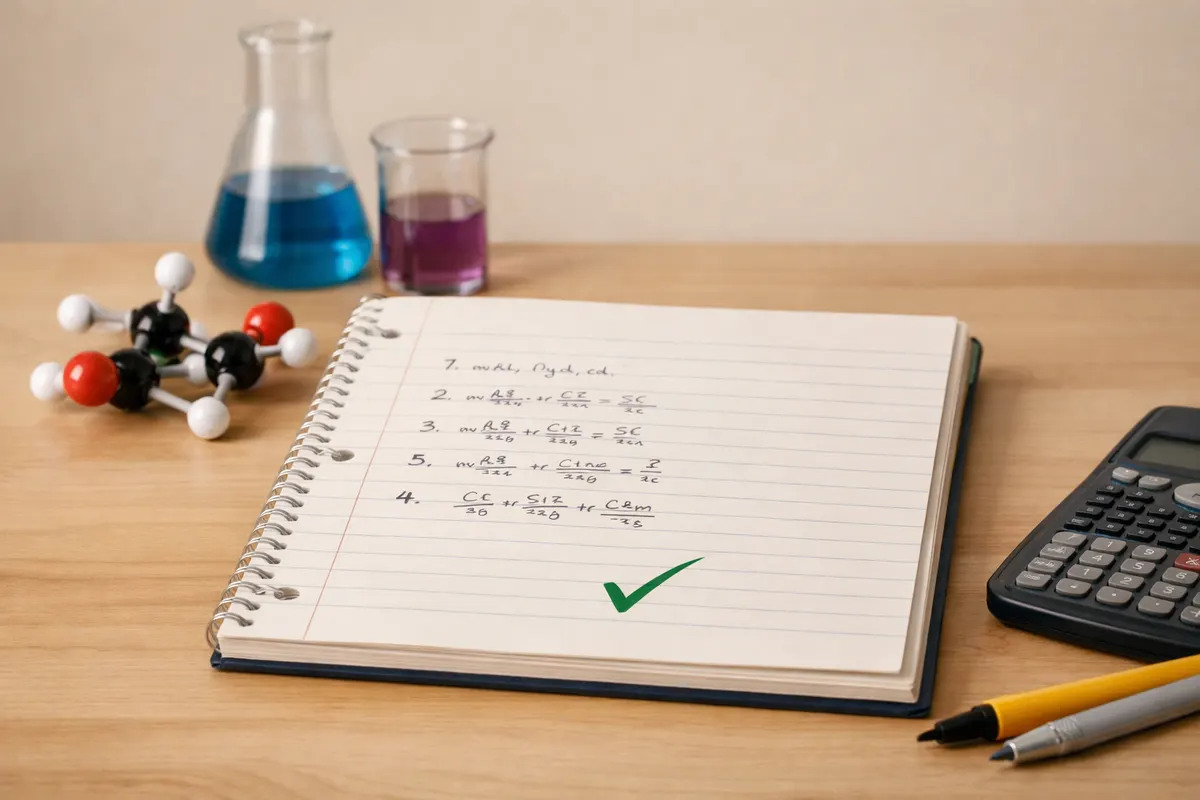
When you ask an ai for chemistry homework question that includes a photo or typed problem, the system is best at converting visible and explicit information into structured steps. That means it can parse a clear chemical equation, identify reagent names and quantities shown in text, balance equations, apply stoichiometry, and show mechanisms or step-by-step algebra when the inputs are unambiguous. For example, a typed reaction like "2 H2 + O2 -> 2 H2O" or a photographed worksheet with legible numbers lets the solver walk through each calculation and show intermediate steps.
AI models also excel at formatting methodical math: unit conversions, mole-to-gram calculations, limiting reagent workflows, titration formula application, or stepwise redox balancing. If you provide the molecular formulas, measured masses or concentrations, and the reaction stoichiometry, the tool can show the arithmetic and symbolic manipulations it used. This turns a black-box final answer into a chain of operations you can follow and check against your notes.
For problems that are fundamentally conceptual—like predicting products for simple organic reactions, identifying functional groups from a clear structural formula, or explaining why an equilibrium favors products—AI can provide plausible reasoning that matches established rules taught in general chemistry and introductory organic courses. Those explanations are useful for learning because they can reference reaction rules (nucleophile strength, acid strengths, resonance) while showing the reasoning steps.
Finally, the solver can suggest likely next checks and point out places where additional context would change the result: missing phases (s, l, g, aq), catalysts, solvent effects, or temperature. It will often present alternative routes and show how an answer would change if a given assumption is different, which helps students understand dependency chains in chemistry problem solving.
- Converts typed or clearly photographed equations into step-by-step arithmetic and symbolic work.
- Balances equations and performs mole, mass, and concentration calculations with shown intermediate steps.
- Explains mechanism outlines and conceptual rules for common reaction classes when structures are clear.
- Flags assumptions (states, solvents, catalysts) that affect which steps are valid.
Where AI falls short for homework and photo-based clues
AI cannot prove purity, identity, or experimental accuracy from a photo or a short problem statement alone. For example, a photo of a white powder cannot reliably tell you whether it is sodium chloride, sucrose, or a different salt with a similar appearance. Even high-resolution images rarely reveal impurities, hydration states, or molecular identity—the kind of determinations that require spectroscopic data, chromatography, or chemical tests in a lab.
Do not let step-by-step output replace your own verification: the AI’s reasoning chain can contain arithmetic or assumption errors, misread symbols (for example interpreting O for 0 or l for 1), or apply the wrong generic rule to a special-case problem. When an answer depends on experimental conditions (pH, temperature, solvent polarity), the system may default to common assumptions that don't match your specific setup, so the presented steps can be correct only under those unstated assumptions.
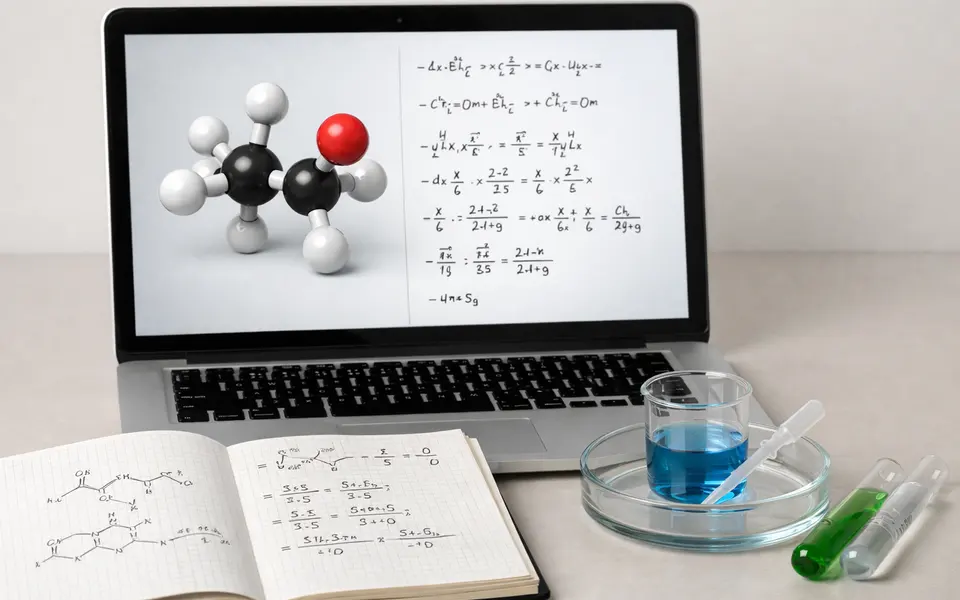
AI also struggles with ambiguous handwriting, slashed zeros, poorly angled photos, and diagrams missing labels. If structural drawings omit stereochemistry or when resonance contributors are drawn inconsistently, the solver may present a plausible pathway that overlooks stereochemical outcomes or tautomeric forms. In short: appearance-based claims, provenance, and safety assessments are outside what a homework-focused ai for chemistry homework tool can prove.
Finally, the AI should not be treated as a substitute for academic honesty. Submitting step-by-step solutions generated by a tool without comprehension can undermine learning and academic integrity. Use the structured output as a study aid and a checklist to confirm your own work, not as a one-click solution to bypass thinking through the steps.
- Cannot confirm chemical identity, purity, or contamination from photos alone.
- May misinterpret handwriting, poor photos, or unlabeled structural drawings.
- Can default to unstated assumptions about conditions that change outcomes.
- Is not a substitute for lab tests (spectra, chromatography) or instructor verification.
Visual clues to check before asking for step-by-step help
Before you use an ai for chemistry homework tool, capture the most stable, unambiguous clues you can. Prioritize clear text and numerical values (masses, volumes, concentrations, purity percent, temperature), typed chemical formulas, and structural formulas drawn with labeled atoms and charges. When structural drawings are present, make sure bonds, lone pairs, and any stereochemical markers (wedges/dashes) are visible; those details change mechanism and product predictions.
Include context in the photo: the full problem statement, any given assumptions, and the complete set of data from the lab notebook or worksheet. For titration or equilibrium problems, a cropped photo that omits the indicator color key or the initial/final volumes will often produce wrong intermediate steps. A single clean, well-lit image that shows the whole problem reduces the chance the AI will guess missing pieces.
Capture scale and units: write units next to numeric values if they are small or ambiguous in the image. A handwritten "1.0" without units or a decimal point can be misread. If surface appearance matters—like color changes in an indicator or precipitate formation—take a sharply focused close-up and include a neutral white background and a color reference card if possible so the solver can better interpret color-based clues.
When the problem depends on molecular structure, photograph or type the SMILES or IUPAC name when available. If you only have a photo of a model kit or a drawn structure, add a typed label for ambiguous atoms (for example, label atom numbers or functional groups). The more explicit you make the inputs, the more reliable and traceable the step-by-step answer will be.
- Type or photograph full problem text, not fragments or cropped images.
- Show numeric values with units and avoid ambiguous handwriting or missing decimals.
- Include clearly labeled structural drawings or typed identifiers (IUPAC/SMILES).
- Use a neutral background and good lighting for color or precipitate clues.
How to verify AI steps and when to seek lab or expert help
Treat the AI’s step-by-step output as a checklist to replicate by hand. Recalculate each intermediate value yourself or with a calculator, and check formula application: did the model use the correct molar masses, significant figures, and unit conversions? For stoichiometry, write out which substance is limiting and confirm the mole ratios the AI used. If you find an arithmetic mismatch, trace back to the line where the model converted units or applied the molar mass—those are common error points.
If the question hinges on experimental identity (what substance formed, whether a reaction reached completion, or the purity of a product), use practical classroom tests or simple bench methods before accepting the AI’s conclusion. Melting point checks, solubility comparisons, simple qualitative tests (flame test, pH strips, silver nitrate for halides) and thin-layer chromatography are standard ways to verify identities at the student-lab level. Emphasize safety: follow your lab's protocols and consult an instructor before performing tests.
For questions that require authoritative analytical proof—IR, NMR, mass spectrometry, elemental analysis, or GC/MS—seek a campus core facility, an instructor, or a professional lab. The AI can help plan what data to request and how to interpret typical spectral features, but it cannot replace raw instrument data or certified lab reports. When results affect safety, credit, or publication, professional verification is the standard.
If you want a second look at the reasoning rather than experimental confirmation, consider peer review: show the AI’s steps to a classmate, TA, or instructor and ask them to point out any mismatches to course conventions. You can also consult the guide 'AI Chemistry Problem Solver: How the Solver Works and How to Check It' (https://chemistry-ai.app/guides/ai-chemistry-problem-solver) for more detail on interpreting solver output and spotting common pitfalls. Use ChemistryAI or a similar app as a focused verification tool: scan the steps, compare each line to your manual work, and treat disagreements as prompts to dig deeper rather than final judgments.
- Recompute intermediate values and unit conversions by hand to confirm the chain of steps.
- Use classroom tests (melting point, solubility, TLC) for practical identity checks when safe.
- Request professional analytical data (NMR, IR, MS) for definitive identification or purity claims.
- Have instructors or peers review solver steps when the outcome affects grading or safety.
Related guides
Use ChemistryAI to check the steps, not skip them
Try ChemistryAI as a second pair of eyes: scan a clear problem or type the full equation, then compare its step-by-step work to your own. Use the app to spot missed unit conversions, alternative approaches, or unstated assumptions, and always recompute key steps by hand or with your calculator. If the solver and your manual work disagree, treat that as a prompt to re-examine the inputs, consult course notes, or ask an instructor. Download ChemistryAI to scan problems, see structured steps, and learn how each line follows from the previous one—but don’t use it as a substitute for double-checking results or for lab verification.
Take the next step →Frequently asked questions
Can I rely on an AI solver to grade my homework?
No. An AI solver can show step-by-step math and reasoning, but it can still make mistakes in arithmetic, assumptions, or interpretation of ambiguous inputs. Use its output to check your work and understand methods, then verify every calculation and assumption before treating the result as graded work.
What should I include in a photo to get accurate step-by-step help?
Include the entire problem statement, all numeric data with clear units, and labeled structural formulas when relevant. Use good lighting, avoid oblique angles, and add typed identifiers for ambiguous handwritten symbols. Showing the experimental conditions (solvent, temperature, catalyst) drastically improves answer accuracy.
If the AI gives two different solution paths, which one is right?
Both paths can be valid if they use different assumptions or conditions. Compare their assumptions—such as solvent, protonation state, or limiting reagent—and test which set matches your problem. If the assumptions differ from your setup, neither may be correct for your case; ask the AI to state its assumptions explicitly and recompute with your specified conditions.
When should I go to a lab or instructor instead of relying on the AI?
Seek a lab or instructor when identity, purity, or safety is at stake, when experimental data contradicts the AI’s steps, or when the problem requires specialized instrumentation (NMR, MS, elemental analysis). Also consult an instructor for academic integrity questions or when the solver’s reasoning conflicts with course-specific conventions.