

Chemistry AI Tutor: What an AI Tutor Explains and What to Verify
Understand what a chemistry ai tutor can infer from images and text, which details need lab checks, and practical steps to verify solutions safely.
What a chemistry AI tutor can do well
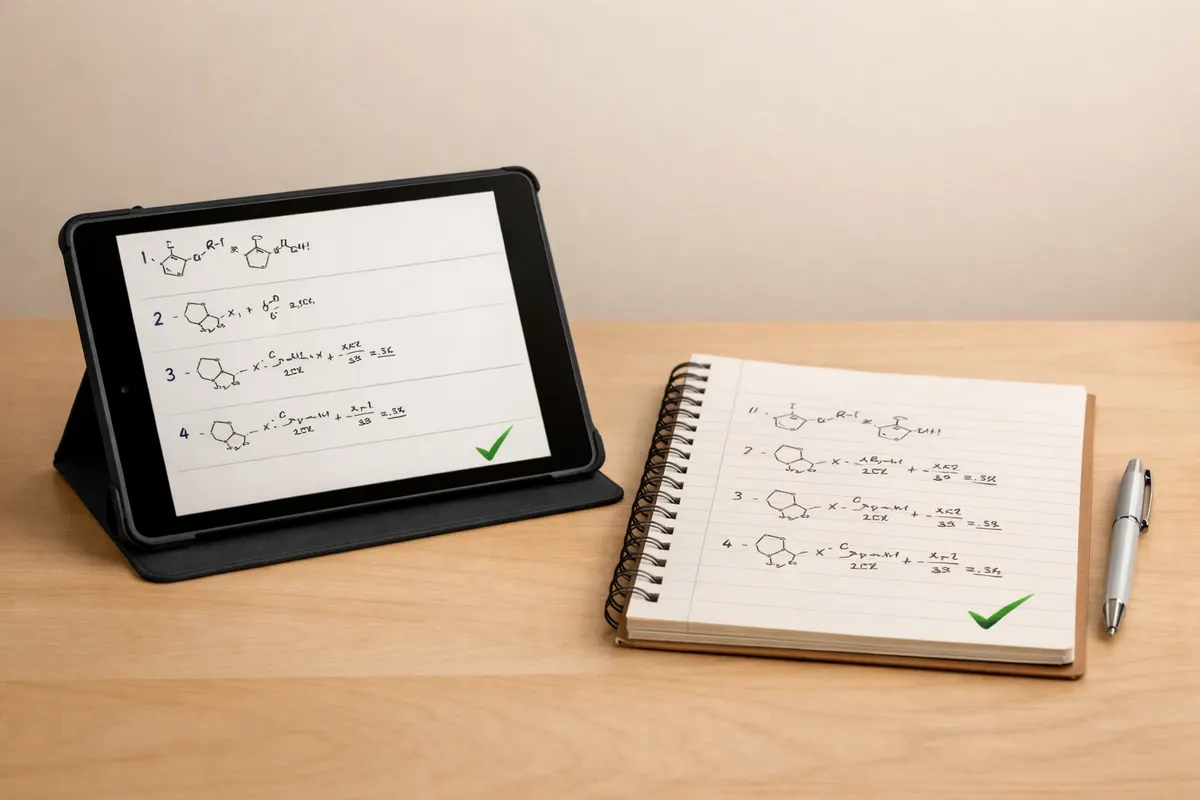
A chemistry ai tutor can be a very effective study partner when you feed it clear inputs: typed problem statements, reaction schemes, labeled photos of an apparatus or sample, and measured quantities. For homework-style problems it excels at step-by-step algebraic work—balancing equations, converting units, calculating moles and concentrations, and walking through stoichiometry with intermediate lines so you can follow the logic.
When you provide a photograph, an ai chemistry solver can identify visible, unambiguous information: reagent labels, printed concentrations on bottles, visible volume marks on graduated cylinders, color changes during a titration, and clear text in a photographed worksheet. From those clues it can suggest likely calculations, show how to set up the limiting reagent check, and produce a reproducible ‘chemistry step by step’ solution you can audit.
The tutor can also explain reasoning: why a reagent is limiting, how to choose the correct titration equivalence point, how to propagate uncertainty qualitatively, or how to pick an appropriate solvent from a visible label. For mechanism-style questions and textbook examples the tool can outline plausible electron-flow arrows, propose intermediates, and link steps to general reaction types while showing the assumptions behind each claim.
Concrete example: give the ai chemistry tutor a photo of a beaker with a labeled 0.10 M NaOH bottle, a 25.00 mL aliquot on a graduated cylinder, and the target mass of an acid. The tutor can compute moles, perform the titration calculations, and show each arithmetic step. It can also highlight inputs that matter—like whether the NaOH concentration was standardized—that you should double-check before accepting the numeric result.
- Step-by-step arithmetic: unit conversion, molar mass lookup, mole ratios, limiting reagent, and yield calculations.
- Recognizing printed labels, numeric markings on glassware, and clear color changes (e.g., endpoint dye shifts).
- Translating a word problem into balanced chemical equations and setting up the correct stoichiometric ratios.
- Explaining reasoning and assumptions so you can replicate or critique each step.
- Identifying likely experimental setups from photos (titration, distillation setup, TLC plate lanes) when details are clear.
What a chemistry AI tutor cannot prove from one photo
A chemistry ai tutor cannot replace laboratory measurements or forensic verification. It can suggest likely identities, expected melting points, or probable impurities, but it cannot certify purity, concentration, or provenance from a single image. For example, a white crystalline powder photographed on a bench may resemble many different sodium salts; only instrumental analysis or chemical tests can determine identity and purity.
The tutor also cannot reliably determine unseen experimental conditions—temperature history, exact reagent concentrations if not labeled, or whether a reaction completed—unless you provide measured data. Color alone is especially fragile: lighting, concentration, and container glass can change apparent hue, so the tutor’s color-based guesses should be treated as hypotheses, not confirmations.
Safety, toxicity, and legal judgments are out of scope. The ai chemistry tutor should not be used to decide whether a substance is safe to handle, ingest, or dispose of; those are decisions that require MSDS information, lab-grade tests, and, for hazardous cases, advice from trained personnel. Similarly, the tutor can’t prove authenticity or value (for reagents, antique apparatus, or regulated compounds) from photos.
Concrete examples of impossible claims: certifying a reagent as ‘analytical grade’ from its bottle photo, proving a compound’s structure from a melting point image alone, or claiming that a captured color means a reaction reached completion. In each case an ai chemistry tutor can flag what additional measurements or documentation are needed, but it cannot deliver the proof itself.
- Certifying purity or exact concentration from a photo is not possible—laboratory analysis is required.
- Proving a reaction completed or yields reported from color change alone is unreliable.
- Determining toxicity, safety, or legal status of a material via images is out of scope; consult SDS and authorities.
- Authenticating provenance (certificate of analysis, supplier traceability) cannot be done from an image.
- Predicting absolute instrument outputs (IR spectra peaks, exact NMR shifts) from a visible sample is not valid.
Visual clues
Good photos improve the quality of an ai chemistry tutor’s responses. Prioritize stable, verifiable clues that aren’t highly sensitive to lighting or camera filters. Labels with typed text, glassware graduations, numeric data written on vials, and printed reagent lot numbers are significantly more useful than color alone. When you tell the tutor exactly what you measured—mass, volume, concentration—it can focus on math and reasoning rather than guessing identity.
Include context shots and close-ups. A wide shot shows experimental setup (type of flask, presence of a stir plate, connections), while a close-up of labels captures exact wording like ‘HPLC grade’ or a molarity printed on the bottle. A simple scale reference—a ruler or a coin—helps the ai understand relative sizes of crystals, droplets, or precipitates when morphology matters to the question.
Photograph time-dependent changes if possible: a sequence that shows a solution before, during, and after an addition (color change, precipitate formation, gas evolution) gives the tutor a richer timeline to analyze than a single still. When recording pH, include pH strips plus the range reading, or a digital meter display when available. Textual context—photographed problem statements, scribbled calculations, and instrument readouts—makes step-by-step checking far more reliable.
Below is a compact checklist to guide what to photograph or note before using an ai chemistry tutor.
- Clear typed labels on reagent bottles (brand, concentration, lot number).
- Numeric markings on glassware (mL lines, burette volume) and a scale reference (ruler or coin).
- Close-up of any written measurements or experimental notes (masses, times, measured volumes).
- Sequence photos for time-dependent changes (before/during/after titration or precipitation).
- Visible safety labels, expiry dates, and storage conditions for hazardous chemicals.
- Instrument displays (analytical balance readout, pH meter screen) photographed legibly.
- Multiple lighting angles to reduce color distortion and show texture or crystal habit.
How to verify AI suggestions: a practical path
Treat the ai chemistry tutor as a reviewer of your reasoning rather than an oracle. Ask it to show every arithmetic step and to state its assumptions explicitly—molar mass values used, significant-figure rules, whether it assumed 100% yield, and what reagent purity was assumed. Working backward through its steps is an efficient first verification: recompute the key arithmetic yourself or with a calculator to confirm that the logic is sound and that units cancel correctly.
For experimental claims or identity guesses, escalate verification in tiers based on risk. Low-stakes classroom checks (homework arithmetic, conceptual mechanism questions) usually require only human review: compare the tutor’s derivation to your textbook, or ask an instructor to confirm. Medium-stakes questions—like estimating concentration from a labeled bottle or troubleshooting an unexpected color change—benefit from simple bench tests: pH strips, a quick titration, melting point check, or thin-layer chromatography (TLC) can confirm or refute the tutor’s hypothesis.
High-stakes decisions need formal lab analysis. If the material is hazardous, regulated, or if you must certify purity or identity for publication, procurement, or safety, send samples to an accredited lab for NMR, IR, GC-MS, HPLC, or elemental analysis as appropriate. When safety is involved, stop and consult a supervisor, safety officer, or a certified chemist before proceeding with any experiment.
Practical verification checklist to follow after the tutor returns a solution:
- Step audit: recompute the numeric steps, check unit consistency, and confirm molar masses used match a trusted source.
- Bench checks: pH meter vs pH paper, small-scale titration, melting point or boiling point test, or simple colorimetric assays.
- Instrumental tests for identity/purity: NMR/IR for structure, GC-MS or HPLC for mixture composition, elemental analysis for stoichiometry.
- Safety and compliance: consult SDS, institutional safety staff, or a qualified chemist for handling, storage, and disposal.
- Document everything: capture photos of measurements, instrument readouts, and the tutor’s step-by-step output so a human reviewer can follow the chain of evidence.
Related guides
Use ChemistryAI to check steps, not to skip them
Before you act on a numeric answer or an identity guess, confirm the visible evidence and run the computations yourself. Use ChemistryAI as a step-checker: scan clear photos of labeled reagents, glassware marks, and instrument readouts, ask the app to show every calculation, and then verify key steps with a quick bench test or instructor review. If results affect safety, compliance, or publication, escalate to formal lab analysis—AI can accelerate checks but not replace measurements or human oversight.
Take the next step →Frequently asked questions
Can a chemistry AI tutor give me an exact concentration from a photo of a vial?
No. A photo can show a printed concentration on a labeled vial, which the tutor can read, but it cannot independently verify that concentration. To confirm concentration you need a measured procedure—standardization, titration, or an instrumental analysis (e.g., HPLC)—and corresponding instrument readouts. Treat any concentration stated without supporting measurements as a claim that needs verification.
How should I use an AI tutor when studying reaction mechanisms?
Use the tutor to generate step-by-step electron flow, propose intermediates, and to compare alternative mechanistic pathways. Ask it to justify each arrow with resonance, acidity/basicity, or steric arguments. Then cross-check its reasoning against a trusted textbook or your instructor: mechanisms are contextual and often rely on subtle experimental conditions that the AI may not know unless you provide them.
What are the quickest checks to reduce mistakes when using an AI chemistry solver for homework?
Recompute the arithmetic and unit conversions yourself, check significant figures, confirm molar mass values from a periodic table, and compare your final answer’s order of magnitude with a rough back-of-envelope estimate. If the problem involves a real experiment, verify any crucial input (volume, mass, concentration) against the photographed instrument display or lab notebook before accepting results.
Is it ever safe to follow an AI tutor’s experimental recommendation without a human supervisor?
No. Never execute experimental procedures solely based on an AI tutor’s recommendation, especially if they involve hazardous reagents, heat, pressure, or regulated substances. The tutor can suggest a plan, but a qualified instructor or safety officer should review procedures, and you should follow institutional safety protocols. For high-risk work, require supervisory sign-off and accredited lab verification.