

Molar Mass CO2: Calculate 44.01 g/mol Step by Step
A clear guide to molar mass CO2: calculate 44.01 g/mol, see the atomic breakdown, use practical checks, and learn how to verify your result.
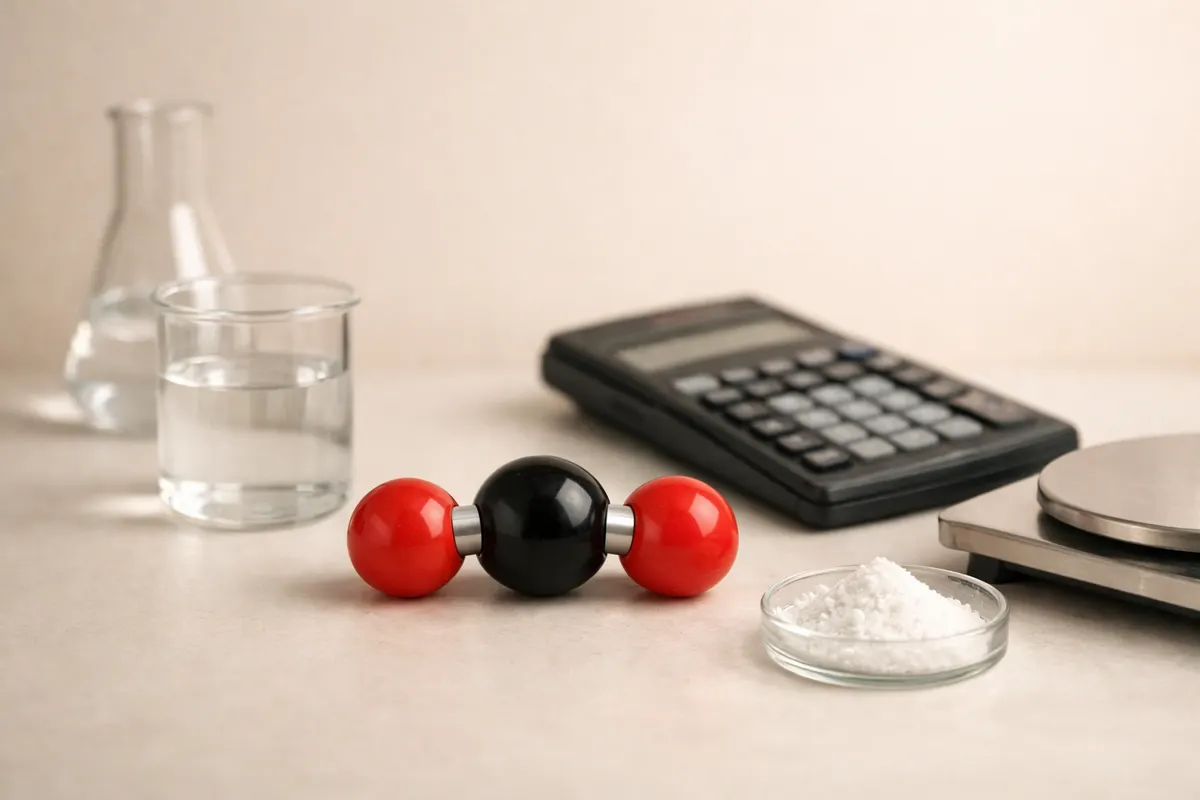
Quick answer for molar mass CO2
The molar mass CO2 is 44.01 g/mol. That value comes from one carbon atom with atomic mass 12.01 and two oxygen atoms at 16.00 each: 12.01 + 16.00 × 2 = 44.01 g/mol.
Use 44.01 g/mol whenever you convert between moles and grams for carbon dioxide in calculations, stoichiometry, and basic lab work. For many classroom problems this rounded set of atomic masses is the accepted standard.
If you need a more precise answer for high‑accuracy work, check isotope‑weighted atomic masses or a trusted molecular weight database, and consider instrumentation for experimental confirmation.
What molar mass CO2 means and why it matters
Molar mass CO2 is the mass of one mole of carbon dioxide. One mole contains Avogadro’s number of molecules (about 6.022×10^23). When we say CO2 has molar mass 44.01 g/mol, we mean one mole of CO2 molecules weighs 44.01 grams by that standard atomic mass convention.
Chemically CO2 is one carbon atom bonded to two oxygen atoms. The molar mass is the sum of the constituent atoms’ masses: carbon 12.01 and each oxygen 16.00. That arithmetic is the core of calculating molecular weights for any formula.
Practically, molar mass converts moles to mass and vice versa. If a reaction produces 0.25 mol CO2, the mass produced equals 0.25 mol × 44.01 g/mol = 11.0025 g. In gas calculations it ties to the ideal gas law when you convert volume, temperature, and pressure into moles and then to grams.
Key clues to check when someone reports molar mass CO2
When you encounter a reported molar mass CO2, confirm the atomic masses and rounding used. Most general chemistry texts use C = 12.01 and O = 16.00. If a source lists slightly different atomic masses, their molar mass may differ by a few hundredths.
Context matters: if the number appears in a lab report or instrument readout, check whether the writer used mass‑spectrometer isotope corrections, experimental density data, or textbook rounding. Those choices shift the last decimal but rarely change routine stoichiometry outcomes.
Photos or labels can support context but cannot by themselves prove a molar mass. A photo of a labeled reagent, a mass spectrum screenshot, or a digital scale readout gives evidence you can cross‑check; it does not replace calculation or instrument calibration records.
- Confirm formula: CO2 = one carbon atom + two oxygen atoms.
- Atomic masses to use: carbon 12.01, oxygen 16.00 (each).
- Perform the sum: 12.01 + 16.00 × 2 = 44.01 g/mol.
- Check rounding rules when precision matters (isotopes, databases).
- Look for supporting instrument data (mass spectrum, calibrated scale) rather than relying on a single photo.
Step-by-step workflow to calculate molar mass CO2
Below is a straightforward, verifiable workflow for calculating molar mass CO2 and using it correctly. Each step is intentionally practical so you can replicate it for other molecules.
Step one: Identify the chemical formula. For carbon dioxide the formula is CO2 — one carbon atom and two oxygen atoms. Writing the correct formula is the most common point where errors begin.
Step two: Look up standard atomic masses. Use commonly accepted classroom values: carbon 12.01 and oxygen 16.00. For general chemistry problems these are the values instructors expect.
- Step three: Multiply the atomic mass by atom counts. For CO2 that is: 12.01 for C, and 16.00 × 2 for O.
- Step four: Sum the results to get molar mass: 12.01 + 16.00 × 2 = 44.01 g/mol.
- Step five: Apply the molar mass. Convert moles ↔ grams by multiplying or dividing by 44.01 g/mol. Example: 0.10 mol CO2 × 44.01 g/mol = 4.401 g.
- Step six: For experimental checks, compare calculated mass with instrument data and account for sources of error such as isotopic composition, calibration offsets, or non‑ideal gas behavior.
Examples that use molar mass CO2 correctly
Textbook calculation example: How many grams are in 2.5 mol CO2? Multiply by the molar mass: 2.5 mol × 44.01 g/mol = 110.025 g before rounding. If 2.5 mol is a measured quantity with two significant figures, report the result as 1.1 × 10² g. Scientific notation makes the intended precision explicit.
Stoichiometry example: If a reaction produces 0.125 mol CO2, the produced mass is 0.125 mol × 44.01 g/mol = 5.50125 g. Keep enough decimal places during intermediate steps and round only in the final reported result according to significant‑figure rules.
Experimental density example (conceptual): You can infer an experimental molar mass using gas density and the ideal gas law, but this requires careful measurement of temperature, pressure, and volume plus corrections for non‑ideal behavior at high pressure. That experimental molar mass should be compared to the calculated 44.01 g/mol and reconciled with measurement uncertainty.
Dimensional analysis makes the conversion direction easier to remember. To change grams into moles, place grams in the denominator of the conversion factor: 8.802 g × (1 mol / 44.01 g) = 0.2000 mol. The gram units cancel, leaving moles. To reverse the calculation, multiply 0.2000 mol by 44.01 g/mol and recover 8.802 g. If your units do not cancel to the requested quantity, stop and invert the conversion factor before continuing.
Keep formula subscripts separate from equation coefficients. The subscript two in CO2 tells you that every carbon dioxide molecule contains two oxygen atoms, so oxygen contributes twice its atomic mass. In a balanced equation, a coefficient such as 2CO2 instead means two molecules or two moles of carbon dioxide. It does not change the molar mass of CO2. Two moles have a total calculated mass of 88.02 g, while the molar mass remains 44.01 g/mol.
A useful comparison is carbon monoxide, CO. It contains one carbon atom and only one oxygen atom, so the same classroom values give 12.01 + 16.00 = 28.01 g/mol. Accidentally dropping the subscript from CO2 therefore changes the substance and produces a different answer. Before checking arithmetic, count the atoms in the formula and write their contributions separately. This simple check catches a mistake that a calculator cannot identify if the wrong formula was entered.
Rounding should reflect the measurements in the problem. For the half-mole example, 0.50 mol has two significant figures, so 22.005 g is an intermediate result and 22 g is the corresponding final value. Keep the unrounded result during a longer calculation and round once at the end. If your teacher supplies different atomic masses, use those values consistently and show them in your working.
- Practical conversion: 1.00 mol CO2 = 44.01 g.
- Half‑mole example: 0.50 mol × 44.01 g/mol = 22.005 g.
- Mass‑to‑mole example: 88.02 g CO2 ÷ 44.01 g/mol = 2.000 mol.
- When using instruments, annotate calibration and uncertainty before trusting experimental molar mass.
Limitations: what molar mass CO2 does and does not tell you
Molar mass CO2 is a theoretical mass based on atomic masses; it is not a direct measurement of a particular sample. Natural samples may contain isotopic variants (for example 13C) that slightly change the average mass. For high‑precision work you must use isotope‑weighted atomic masses or measure the specific sample composition.
Photos and labels help with context but cannot measure molar mass. A photograph of a container marked “CO2” or a gas cylinder label may confirm identity, but photos do not replace calculations or instrument calibration records. Do not conclude a precise molar mass from visual evidence alone.
Experimental methods that can estimate or measure molar mass include mass spectrometry, gas density experiments, and gravimetric analysis. Each method has its own uncertainty: mass spectrometers require calibration, density methods need accurate temperature and pressure control, and gravimetric approaches depend on complete reactions and pure products. Verify with trusted instrumentation when the decision depends on high accuracy.
- High confidence: Calculated molar mass using standard atomic masses (12.01, 16.00).
- Partial confidence: Experimental agreement within reported instrument uncertainty.
- Low confidence: Solely photographic evidence, unlabeled claims, or rounded reporting without method notes.
- When to verify: legal, safety, regulated, or high‑precision research contexts — use instrument records or a lab service.
Related guides
Next step for CO2 calculations and checks
If you want to run conversions or check a worked solution quickly, use ChemistryAI’s molecular weight calculator at https://chemistry-ai.app/tools/molecular-weight-calculator for stepwise results based on the same atomic masses used here. For guidance on verifying solver outputs, see our explainer on the AI Chemistry Problem Solver (https://chemistry-ai.app/guides/ai-chemistry-problem-solver). Treat the app as a fast first pass after you confirm visible evidence and instrument notes; always verify critical results with calibrated measurement or a trusted lab.
Take the next step →Frequently asked questions
What is the exact calculation that gives 44.01 g/mol for CO2?
Start with the formula CO2: one carbon atom and two oxygen atoms. Use standard atomic masses: carbon = 12.01, oxygen = 16.00. Multiply oxygen by two and add: 12.01 + 16.00 × 2 = 44.01 g/mol. The unit g/mol indicates grams per mole and converts moles of CO2 into mass.
Can I rely on a photo of a label to determine molar mass CO2?
No. A photo of a label can confirm that a container is labeled CO2 and provide context, but it cannot establish molar mass by itself. Molar mass is a calculated property based on atomic masses or an experimentally measured result requiring calibrated instruments. Use the photo only as supporting evidence and verify with calculation or instrument data.
How do I convert grams of CO2 to moles using molar mass CO2?
Divide the mass in grams by the molar mass CO2. For example, 22.005 g ÷ 44.01 g/mol = 0.5000 mol. Always include the unit g/mol in the molar mass and keep sufficient decimal places during intermediate steps, rounding only in the final reported value as required by significant‑figure rules.
When should I use a measured molar mass instead of the standard 44.01 g/mol?
Use a measured molar mass when sample composition deviates from standard isotopic abundance, when impurities are present, or when your work requires greater precision than textbook rounding provides. Measured molar masses come from instruments like mass spectrometers or carefully controlled density experiments and must include calibration and uncertainty documentation.